
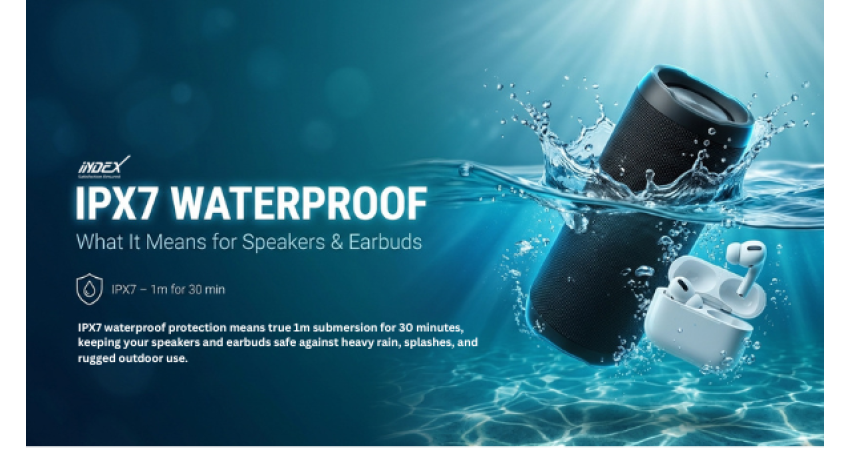
What Does IPX7 Waterproof Mean for Speakers and Earbuds?
IPX7 means a device can survive being submerged in fresh water up to 1 metre deep for 30 minutes. But it does not mean you can swim with it or charge it wet. This guide explains what every IPX rating really means, how the tests work, which rating suits your speaker or earbuds, and how to keep that protection working through a Bangladeshi monsoon.
What is an IP rating?
An IP rating is a standard code that tells you how well a device is sealed against dust and water. IP stands for Ingress Protection. It is an international standard, IEC 60529, that describes how well a device is sealed against solid objects like dust and against water. The rating has two digits after "IP". The first digit is for solids and dust, from 0 to 6. The second digit is for water, from 0 to 9.
When you see an "X" in place of the first digit, as in IPX7, it simply means the product was not tested for dust. It does not mean zero dust protection, only that the manufacturer did not certify it. So IPX7 is a water rating, and IP67 is the same water rating plus full dust protection.
The value of an IP rating is that it replaces vague marketing words with a defined test. Words like "water-resistant", "splash-proof" or "all-weather" have no fixed meaning, and two brands can use the same word for very different levels of sealing. A number such as IPX5 or IPX7 refers to a specific laboratory procedure with a set amount of water, a set direction, a set pressure or depth, and a set time. When you compare Bluetooth speakers or earbuds side by side, the IP code is the only water claim you can compare fairly.
What the first digit means: dust and solids
The first digit matters more than most buyers think, especially for speakers that go to the beach or a dusty rooftop. Here is how the solid-particle scale works under IEC 60529.
| First digit | Protection against solids | What it means for audio gear |
|---|---|---|
| X | Not tested | No dust claim; the product may still be well built |
| 0 | No protection | Rarely printed on consumer products |
| 1 to 4 | Objects from 50 mm down to 1 mm | Keeps out fingers, tools and wires, not dust |
| 5 | Dust-protected | Some dust may enter but not enough to harm operation |
| 6 | Dust-tight | No dust enters; best for sand and dusty sites |
Most portable speakers and earbuds in Bangladesh carry only a water rating, such as IPX5 or IPX7. That is normal. Certifying dust protection is a separate test, and many brands skip it to save cost. If you often take a speaker to Cox's Bazar or Kuakata, though, sand is a real concern, and a product with a 6 in the first position (IP67) has been proven against it.
What does IPX7 mean in simple terms?
IPX7 means the device survived a test of temporary immersion in fresh water up to 1 metre deep for 30 minutes without harmful water getting inside. In real life, that means a speaker that falls into a bucket, gets caught in heavy rain, or drops into a shallow pool should survive if you pull it out and dry it properly.
It does not mean the device is built for underwater use. It is not tested against moving water while swimming, high-pressure jets, hot water, salt water, soap or chlorine. Think of IPX7 as strong accident protection, not as a swimming rating.
How the IPX7 test is actually done
In the IEC 60529 immersion test, the device is placed in a tank of still, clean water so that its lowest point sits about 1 metre below the surface and its highest point is at least 15 centimetres below the surface. It stays there for 30 minutes. Afterwards, the device is checked for water inside and for any harm to how it works. The water is kept close to the temperature of the device, so there is no sudden heat or cold shock during the test.
Three details from that test explain most real-world failures. First, the water is still, so there are no waves, currents or arm strokes pushing water harder against the seals. Second, the water is fresh, so there is no salt, chlorine or soap to attack rubber gaskets. Third, the test is done on a new unit, so it says nothing about how well seals hold up after a year of drops, sun and heat.
Why "waterproof" is the wrong word
No IP rating promises that a device is waterproof forever, under any condition. The standard describes protection against ingress under defined test conditions. Brands and shops often say "waterproof" because it is the word buyers search for, but "water-resistant to IPX7" is the more honest description. Keeping that difference in mind will stop you from treating an IPX7 speaker like a diving tool.
All IPX water ratings compared
The second digit of an IP code runs from 0 to 9, and each level describes a different kind of water exposure, not just "more water". Speakers and earbuds sold in Bangladesh usually carry IPX4, IPX5, IPX6 or IPX7. Higher numbers generally mean more protection, although IPX7 and IPX8 test immersion while IPX5 and IPX6 test water jets.
| Rating | Protects against | Real-life meaning |
|---|---|---|
| IPX0 | No water protection | Keep fully dry |
| IPX1 | Vertically dripping water | Light condensation drips |
| IPX2 | Dripping water when tilted up to 15 degrees | A few drops at an angle |
| IPX3 | Spraying water up to 60 degrees from vertical | Light drizzle from above |
| IPX4 | Splashing water from any direction | Sweat and light rain |
| IPX5 | Low-pressure water jets | Heavy sweat, rain, rinsing under a tap |
| IPX6 | Powerful water jets | Heavy rain and strong splashes |
| IPX7 | Immersion up to 1 m for 30 minutes | Survives drops in water |
| IPX8 | Immersion beyond 1 m, as set by the maker | Deeper or longer immersion |
| IPX9 | High-pressure, high-temperature jets | Industrial wash-down; rare on audio gear |
Are IP ratings cumulative?
No, not automatically. This is one of the most misunderstood parts of the standard. Up to IPX6, a higher rating usually implies the lower spray and splash tests are also met. But the immersion ratings, IPX7 and IPX8, are a different kind of test. A product that passed immersion in still water has not necessarily passed a powerful jet test, because a strong jet hits the seals from a direction and with a force that still water does not.
That is why some products list two ratings together, such as IPX6/IPX7. It means the maker tested both jets and immersion. If a speaker lists only IPX7, it is well protected against being dunked, and in everyday use it will handle rain without trouble, but the jet test was not part of its certification. For a speaker, that rarely matters. You are far more likely to drop it in a puddle than to spray it with a hose.
What IPX8 really promises
IPX8 means continuous immersion under conditions that the manufacturer states and that are more severe than IPX7. The standard does not fix one depth or time for IPX8, so one product may be rated for 1.5 metres and another for several metres. If you see IPX8, look for the depth and time on the product page or in the manual. Without those numbers, IPX8 alone does not tell you how deep the device can go.
What IPX7 does not protect against
IPX7 does not protect against swimming, salt water, chlorine, soap, hot water, steam, or water forced in by pressure. These are the situations where rated devices most often fail, and none of them are part of the IPX7 test. Knowing this list is the single most useful thing you can take from this guide.
- Swimming and diving: moving through water, jumping in, or being hit by a wave creates pressure on the seals that can be higher than still water at 1 metre.
- Salt water: salt crystals left behind after drying can corrode metal contacts and wear down gaskets over time.
- Chlorinated pool water: chlorine is harsh on rubber seals and adhesives with repeated exposure.
- Soap, shampoo and detergent: these lower the surface tension of water, so it can slip through gaps that plain water cannot pass.
- Hot water, showers and saunas: heat softens seals and steam can get through gaps that liquid water cannot.
- Long-term submersion: 30 minutes is the test limit; leaving a speaker floating in a pool all afternoon goes well beyond it.
- Open ports: if a rubber flap over the charging port is not fully closed, the rating no longer applies.
Myths about waterproof speakers and earbuds
A common myth is that an IPX7 speaker can be used in the shower every day. The rating is about cold, still water, and daily steam is exactly the kind of slow, repeated exposure that ages seals. Another myth is that IPX7 earbuds are fine for swimming laps. Apart from the pressure and chlorine issues, standard Bluetooth signals travel very poorly through water, so the music would cut out the moment your head goes under, even if the earbuds survived.
A third myth is that a higher number is always the better buy. A higher water number tells you nothing about sound quality, battery life, Bluetooth stability or comfort. If you never take earbuds near more than sweat and rain, paying extra only for a bigger IP number does not improve your daily experience.
IPX7 vs IPX5 vs IP67: what is the difference?
IPX7 protects against brief immersion, IPX5 protects against water jets and splashes but not immersion, and IP67 adds certified dust-tight protection to the same water level as IPX7. Those three codes cover most portable audio sold in Dhaka, so it is worth seeing them side by side.
| Question | IPX5 | IPX7 | IP67 |
|---|---|---|---|
| Survives heavy rain? | Yes | Yes | Yes |
| Survives sweat during workouts? | Yes | Yes | Yes |
| Survives a drop into a bucket or pool? | Not tested | Yes, up to 1 m for 30 min | Yes, up to 1 m for 30 min |
| Certified against sand and dust? | No | No | Yes, dust-tight |
| Safe for swimming? | No | No | No |
| Typical products | Earbuds, open-ear headphones | Portable speakers | Rugged outdoor speakers |
The practical gap between IPX5 and IPX7 is the accidental dunk. If an IPX5 device falls into a water bucket in a bathroom or slips off a boat into a haor, water may get in, because it was never tested under the surface. An IPX7 device was. For earbuds that live in your ears, a full dunk is rare, which is why IPX5 is common there. For speakers that sit on tables, railings and boat decks, a dunk is much more likely.
The gap between IPX7 and IP67 is dust and sand. In Dhaka, ordinary road dust and construction dust are everywhere, but most of the time they settle on the outside of a speaker grille and can be brushed off. Fine beach sand is different, because it gets into buttons, grilles and port flaps. If you are a regular beach visitor, IP67 is worth looking for. If not, IPX7 is enough.
Which rating do you need?
For earbuds, IPX4 or IPX5 is usually enough; for portable speakers that go outdoors, choose IPX7. For earbuds used at the gym, on a run or during a rickshaw ride in the rain, IPX4 or IPX5 is enough, because earbuds face sweat and splashes rather than full immersion. For portable speakers that go to picnics, rooftops, beaches and boat trips, IPX7 is the better choice, since speakers are more likely to be dropped or left out in a sudden monsoon shower.
Earbuds
IPX4 or IPX5 handles sweat and rain. Examples: HiFuture ColorBuds3 and FlyBuds4, both IPX5.
Portable speakers
IPX7 survives drops in water. Examples: HiFuture Ripple and LINO S, both IPX7.
Choosing by user type
The right rating depends far more on your habits than on the product category. Use the table below as a quick match between how you live and what to look for.
| User type | Main water risk | Suggested minimum |
|---|---|---|
| Office commuter on bus, CNG or rickshaw | Monsoon rain, sweat | IPX4 earbuds |
| Gym-goer or runner | Heavy sweat, rinsing | IPX5 earbuds or open-ear headphones |
| Student who studies at home | Spilled tea or water on the desk | IPX4 or above |
| Rooftop and picnic host | Sudden showers, spilled drinks | IPX7 speaker |
| Traveller to haors, rivers and boat trips | Drops into water | IPX7 speaker |
| Regular beach visitor | Sand, salt spray, waves | IP67 speaker, rinsed after use |
| Bathroom or kitchen listener | Splashes, steam | IPX7 speaker kept away from direct steam |
What about headphones and smartwatches?
Over-ear headphones often have no water rating at all, because their cushions, hinges and fabric are hard to seal and they are rarely worn in heavy rain. Open-ear sports models are a different story, and some carry IPX5 so they can handle sweat, such as the VibeMate open-ear model; you can compare others in the HiFuture headphone range. If you want a headphone for the gym, check the listed rating first. Smartwatches are worn in rain and while washing hands, so their water protection is often described differently, sometimes in ATM or metres rather than IPX. When you browse HiFuture smartwatches, read each product page for the exact water claim before wearing one in water.
Why water ratings matter in Bangladesh
Water ratings matter more in Bangladesh than in many countries because of the long monsoon, high humidity, waterlogged streets and a culture of outdoor gatherings. A device that would stay dry all year in a desert city faces rain, sweat and splashes almost daily here from June to October.
Think about a normal rainy-season day in Dhaka. You leave home in light drizzle, get caught in a sudden downpour while waiting for a bus, ride a rickshaw with the hood half up, and walk through ankle-deep water near your office. Earbuds in your ears and a phone in your pocket are exposed the entire time. IPX4 or IPX5 earbuds handle this easily. Unrated earbuds may also survive, but you are relying on luck rather than a tested seal.
Outdoor gatherings and trips
Rooftop parties, family picnics, university trips and Eid get-togethers are where portable speakers earn their place. They are also where speakers get knocked off tables, left on wet grass, or sprayed by a sudden storm. A boat trip on the Tanguar Haor or a river outing in Sylhet adds the very real chance of a speaker going over the side. In these cases, IPX7 turns a disaster into a minor inconvenience, provided you can reach the speaker quickly.
Humidity and storage
High humidity is a quiet risk that IP ratings do not address directly. A sealed speaker kept in a damp cupboard for months can still develop corrosion on its exposed charging contacts or USB-C port. Store devices in a dry, ventilated place, and if a speaker has been in damp air for a long time, let it sit in a dry room before charging.
Charging during load-shedding
When load-shedding hits, many people charge speakers and earbuds from power banks, laptop ports or wherever a socket is free, sometimes right after coming in from the rain. This is exactly when people forget to check that the port is dry. Make it a habit to wipe and air-dry the port before plugging in any cable. Good quality cables from our converter and cable accessories range also fit the port cleanly, which reduces strain on the seal around the socket.
IPX7 speakers and IPX5 earbuds at Index IT
Index IT lists several HiFuture speakers with IPX7 and several earbuds and open-ear headphones with IPX5, each with the rating stated on the product page. If water resistance is your priority, these models list a clear rating on their product pages at Index IT.
| Product | Rating | Battery | Price |
|---|---|---|---|
| HiFuture Pocket S speaker | IPX7 (1 m / 30 min) | Up to 8 hrs | 2,600৳ |
| HiFuture LINO S speaker | IPX7 (1 m / 30 min) | Up to 10 hrs | 4,899৳ |
| HiFuture ASCENDO speaker | IPX7 | Up to 15 hrs | 5,999৳ |
| HiFuture Passion S speaker | IPX7 | Up to 10 hrs | 7,199৳ |
| HiFuture Ripple speaker | IPX7 | Up to 12 hrs | 8,199৳ |
| HiFuture Gravity speaker | IPX7 | Up to 8 hrs | 11,199৳ |
| HiFuture ColorBuds3 earbuds | IPX5 | Up to 25 hrs combined | 2,299৳ |
| HiFuture ChromeBuds earbuds | IPX5 | Up to 6 hrs (30 hrs with case) | 3,900৳ |
| HiFuture VibeMate open-ear | IPX5 | See product page | 3,900৳ |
| HiFuture FlyBuds4 ANC earbuds | IPX5 | Up to 10 hrs | 5,099৳ |
Ratings, battery figures and prices as listed on Index IT in October 2026.
How to pick among these speakers
All six speakers above share the same IPX7 rating, so water protection is not what separates them. The differences are size, output and battery. The Pocket S at 5W is the one to clip to a bag for a rainy commute or a short trip, and its listing states the full 1 metre, 30 minute test. The LINO S at 12W and the ASCENDO at 20W step up in volume, and the ASCENDO's listed 15 hours of playback makes it the longest-running speaker in this group, a real plus when load-shedding means you cannot always recharge.
The Passion S at 10W lists Bluetooth 6.0, the newest version among these models. The Ripple at 30W and the Gravity at 45W are the choices for a rooftop or picnic where a small speaker would struggle to fill the space. Because they are larger and heavier, they are also the ones most likely to be set down on a wet surface, so IPX7 is a sensible match. You can see the full lineup on our HiFuture speaker page, and the wider choice of brands under speakers.
How to pick among these earbuds
The ColorBuds3 is the lowest-priced IPX5 option in this table and lists up to 25 hours of combined playback with its case. The ChromeBuds adds ENC for clearer calls, which helps when you take calls on noisy Dhaka roads. The FlyBuds4 adds active noise cancellation and Bluetooth 5.4. If you prefer to hear traffic around you while running or cycling, the VibeMate open-ear design leaves your ear canal open and also lists IPX5. Browse more options on the HiFuture earbuds page or across all earbuds.
Not every HiFuture model at Index IT, such as the larger karaoke and party speakers, is shown in this table, because this guide only lists models whose water rating we could confirm. If you plan to take any speaker outdoors, open its product page and confirm whether a water rating is stated before you buy. If no rating is stated, treat it as a device that must be kept dry.
Buying checklist for water-resistant audio
Before you buy a water-resistant speaker or earbuds, confirm the exact IP code, check whether the charging case or port has protection, and match the rating to how you actually use the device. A few minutes on the product page can save you from a wet and dead device later.
- Look for a full IP code such as IPX5 or IPX7, not just the word "waterproof".
- For IPX8, find the stated depth and time; the code alone does not include them.
- Check whether the charging port has a rubber cover or is designed to be exposed.
- For earbuds, assume the charging case is not water-resistant unless the listing says it is.
- Read the warranty terms and note whether liquid damage is excluded.
- Match battery life to your trips; a long outing in the rain is no place to run out of charge.
- Consider dust protection (IP6X) if you often visit the beach.
- Buy from a seller who lists the rating clearly, so you have a written claim to refer to.
It also helps to think about what else you carry. A water-resistant speaker does little good if your phone is unprotected in the same rain. A pouch or case from our mobile phone accessories range keeps the source device as safe as the speaker it is streaming to.
What to do if your speaker or earbuds get wet
If a speaker or earbuds get wet, turn them off, wipe them, shake out water from grilles and ports, and let them air-dry fully before charging. The steps below apply to rated and unrated devices alike, although rated devices have a much better chance of coming through.
Step-by-step drying routine
- Get it out fast: every second counts with immersion, and IPX7 is only tested to 30 minutes.
- Turn it off and unplug it: do not keep playing music to "test" it while wet.
- Rinse if needed: after salt water, pool water or soapy water, rinse gently with clean fresh water.
- Shake and drain: hold the speaker grille-down and shake gently; tap earbuds nozzle-down on a towel.
- Wipe the outside: use a soft, lint-free cloth on the body, buttons and port area.
- Air-dry: leave it in a dry, ventilated room, ideally near a fan, for several hours.
- Check the port: make sure the charging port is completely dry before any cable goes in.
Why the sound is muffled after getting wet
A wet speaker often sounds quiet or muffled for a while, even when nothing is damaged. That is because water sits on the grille and the driver's surface and blocks the movement of air. As it dries, the sound normally returns to normal. Some speakers can push out water if you play low-volume audio once the outside is wiped, but do not blast music at full volume while it is soaked, since that strains the driver.
Common drying mistakes
Avoid putting a wet device in direct hot sunlight on a tin roof, on a stove, or under a hair dryer on a hot setting. Heat can warp the plastic and damage the very seals that protect the device. Putting it in a bag of rice is another popular habit, but rice does very little that ordinary air drying with a fan does not, and it can leave dust and starch in the ports. Do not poke cotton buds or pins into grilles or microphone holes, because they can tear the fine mesh that keeps water and dust out.
How to care for a waterproof speaker or earbuds
To keep water resistance working, protect the seals: close port covers, keep devices away from heat, rinse off salt and chemicals, and never charge a wet device. Water resistance is not permanent. Seals wear out with age, drops and heat, so a two-year-old device may not resist water as well as a new one. A few habits keep your device safe for longer.
- Close any rubber port covers fully before exposure to water.
- Never charge a wet device; dry the charging port completely first.
- Rinse with clean fresh water after contact with salt water, pool water or soap, then dry it.
- Avoid hot water, showers and saunas, since steam and heat damage seals.
- Remember that most brands do not cover water damage under warranty, even on rated products.
Routine care through the year
Once a month, look at the rubber flap over the charging port if your speaker has one. If it is torn, stretched or no longer sits flat, the IPX7 protection is weakened, because the port is often the weakest point. Wipe the grille with a slightly damp cloth to remove dust, and dry it straight after. For earbuds, clean the ear tips and the mesh over the speaker nozzle with a dry, soft brush, since built-up earwax and sweat salts can block the mesh and hold moisture against it.
Earbud charging cases deserve extra care. Many cases have no water rating, and their metal charging pins can corrode if wet earbuds go straight back inside. After a sweaty run or a walk in the rain, wipe the earbuds and let them dry for a few minutes before putting them in the case. If you notice green or white deposits on the pins, the earbuds may stop charging reliably.
Drops and physical damage
A speaker that has been dropped hard on concrete may have a hairline crack or a shifted seal that you cannot see. After a heavy fall, treat the device as if it has lost some of its water protection and keep it away from water until you are confident it is intact. A carry strap or a padded bag from our accessories range lowers the chance of those falls in the first place.
Common mistakes buyers make with IPX ratings
The most common mistake is treating an IP rating as a lifetime guarantee against all water, when it is really a result from one lab test on a new device. Most other mistakes come from that same misunderstanding.
One frequent mistake is buying a speaker for pool parties and letting it float in the pool for hours. That goes far beyond the 30-minute test, and pool water contains chlorine. A better approach is to keep the speaker on the poolside, where splashes and the odd fall are covered by IPX7, and fish it out quickly if it goes in.
Another mistake is taking an IPX7 speaker to the beach and leaving it on wet sand where waves wash over it. Waves bring salt, sand and moving pressure all at once. Keep the speaker on a towel or bag above the waterline, and give it a fresh-water rinse and full dry when you get back to your hotel.
A third mistake is assuming earbuds and their case share the same rating. A buyer may wear IPX5 earbuds in heavy rain without problems and then drop the open case in a puddle, only to find the case no longer charges. Keep the case in a closed pocket or bag on rainy days.
Finally, many buyers compare speakers only by the IP code and ignore everything else. Two IPX7 speakers can differ hugely in volume, battery life and Bluetooth version. Use the rating to filter out models that cannot handle your conditions, and then choose among the remaining ones by sound and features. For a broader view of what suits a room or a living space rather than outdoor use, our speaker and home theater section covers products where water resistance matters less.
Does warranty cover water damage?
In most cases, no: brands usually exclude liquid damage from warranty, even when a device has a water rating. This surprises many buyers, but it follows from how ratings work. A rating says the product passed a test when new; it does not promise the product will survive every exposure for the life of the warranty.
At Index IT, the HiFuture speaker listings state a 1 year warranty, and the earbud listings state official brand warranty. Warranty normally covers manufacturing faults, such as a speaker that stops charging or a driver that fails without misuse. Water damage, physical damage and opened devices are commonly excluded, so read the terms on the product page before you buy.
How to protect yourself
- Keep your invoice and the product box until the warranty period ends.
- Do not open the device yourself after it gets wet; it may void the remaining warranty.
- If a device fails soon after normal use with no water exposure, report it as a fault promptly.
- Be honest about any water exposure; service checks can often detect liquid contact.
Treat the IP rating as a safety margin and the warranty as cover for factory faults. Neither is insurance against carelessness, so good handling habits remain your best protection.
Final word
IPX7 is a very useful rating for portable speakers in Bangladesh, where sudden rain and outdoor gatherings are common. It means your speaker can survive a dunk in fresh water, not that it is designed to live underwater. For earbuds, IPX4 or IPX5 is usually enough. Choose the rating that matches how you actually use your device, and look after the seals so the protection lasts.
If you want a speaker for rooftops, picnics or boat trips, start with the IPX7 models listed above and choose by size and battery. If you want earbuds for commuting and workouts, IPX5 models give you rain and sweat protection without paying for immersion you will rarely need.
Bluetooth speakers EarbudsFrequently Asked Questions
Can I swim with IPX7 earbuds or speakers?
It is not recommended. IPX7 is tested in still fresh water, while swimming adds movement, pressure and often chlorine or salt. Bluetooth audio also drops out underwater.
Is IPX7 better than IPX5?
For immersion, yes. IPX7 survives being submerged, while IPX5 protects against water jets and splashes but not full immersion.
What is the difference between IPX7 and IP67?
Both have the same water protection. IP67 is also certified fully dust-tight, while IPX7 was not tested for dust.
Does warranty cover water damage on IPX7 devices?
Usually not. Most brands exclude liquid damage from warranty even when a device carries a water rating.
Can I use an IPX7 speaker in the shower?
Occasional splashes are fine, but daily hot water and steam age the seals, and the IPX7 test uses cool, still water. Keep it away from the direct spray.
Can I use IPX7 speakers at the beach?
Yes, with care. Keep it above the waterline, away from waves and sand, and rinse it in fresh water and dry it after salt exposure.
Is IPX5 enough for earbuds in the monsoon?
Yes. IPX5 covers heavy rain and sweat, which is what earbuds face on a rainy commute. Just keep the charging case dry.
Why does my speaker sound muffled after getting wet?
Water on the grille and driver blocks air movement. Once the speaker dries fully, the sound usually returns to normal.
Does an IPX7 rating last forever?
No. Seals wear with age, heat, drops and chemicals, so an older device may resist water less well than when new.
What does the X in IPX7 mean?
It means the product was not tested for dust or solid particles. It is not a zero rating, only the absence of a dust certification.

There are no comments for this Article.